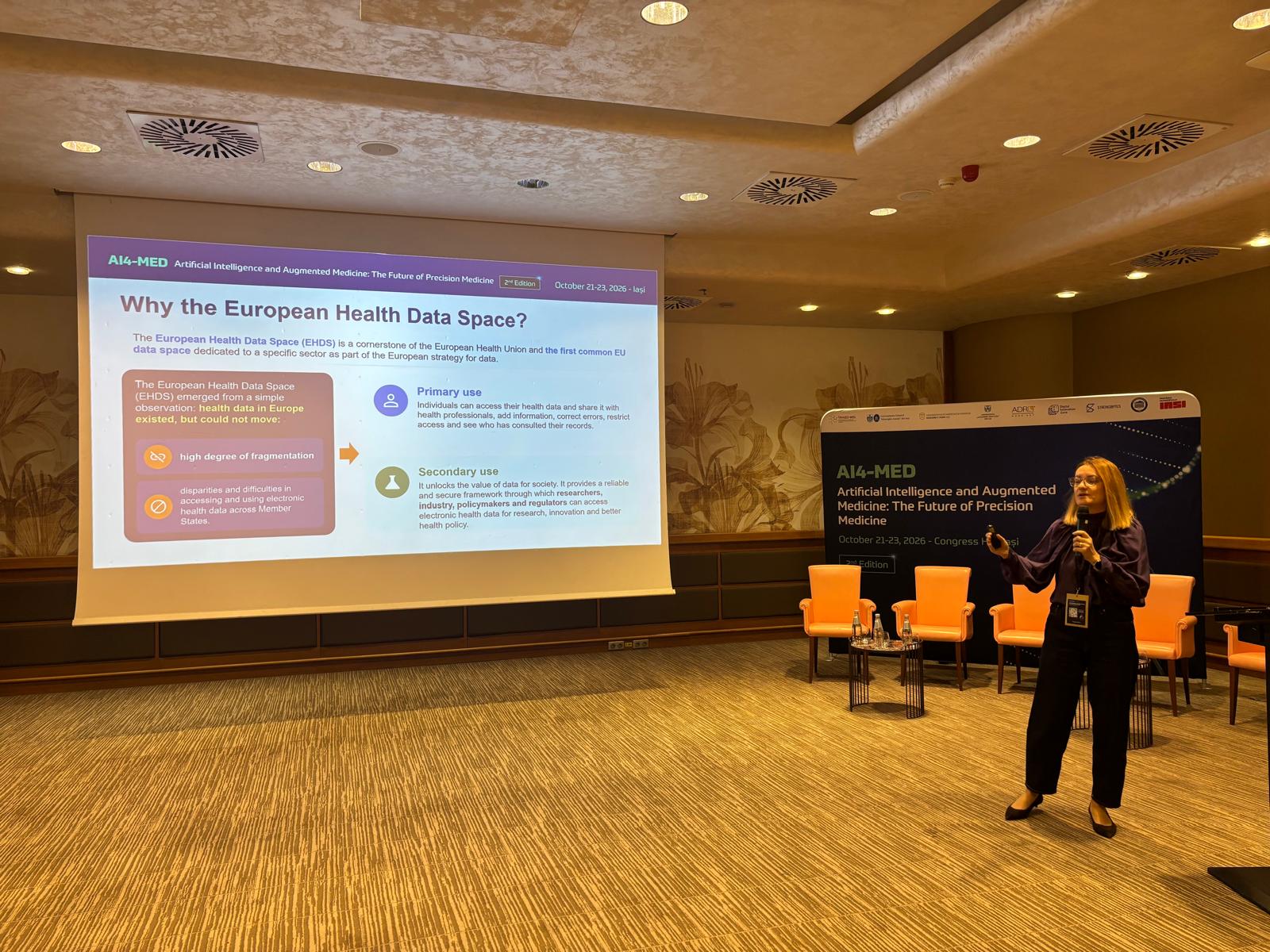
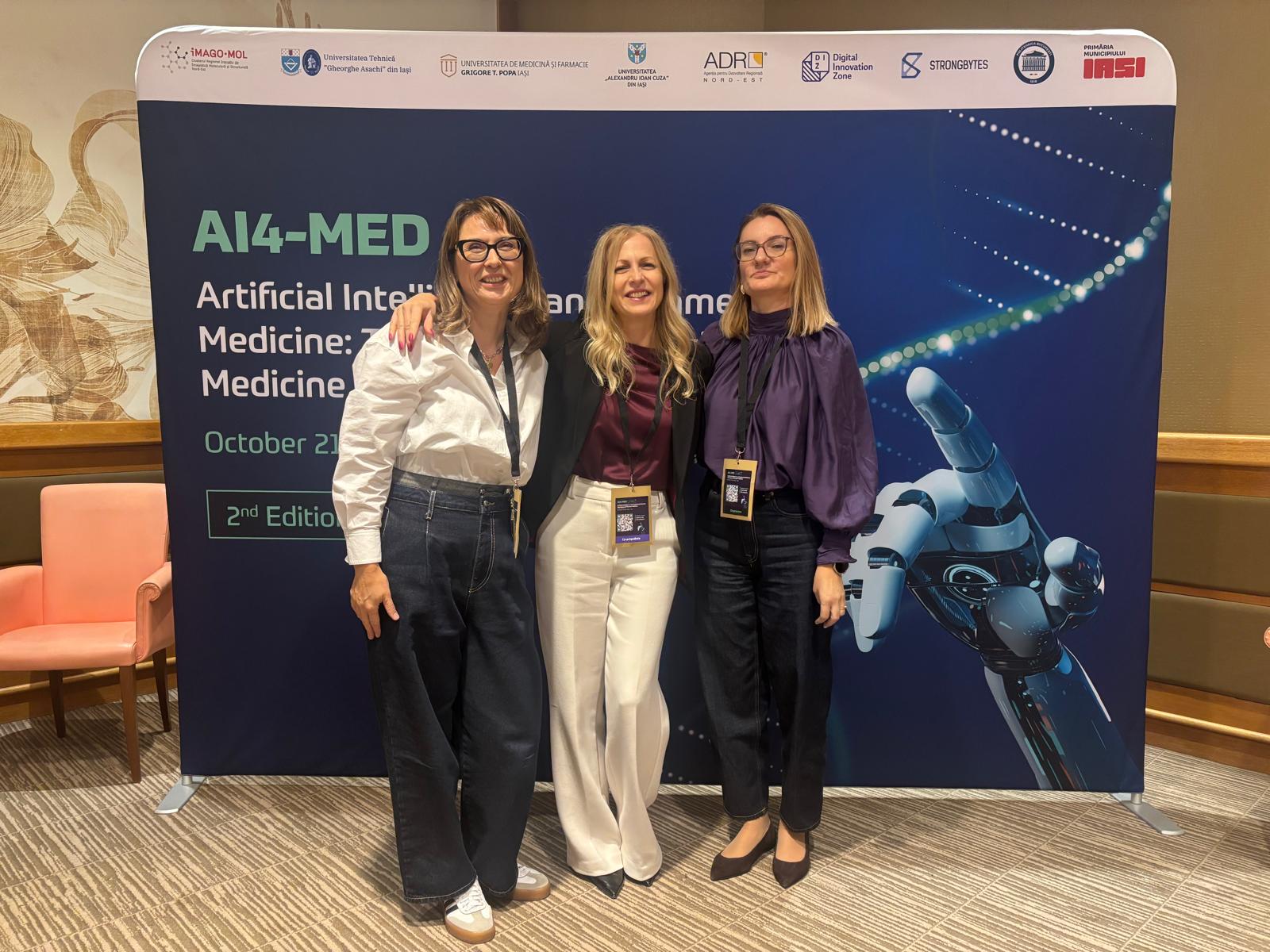
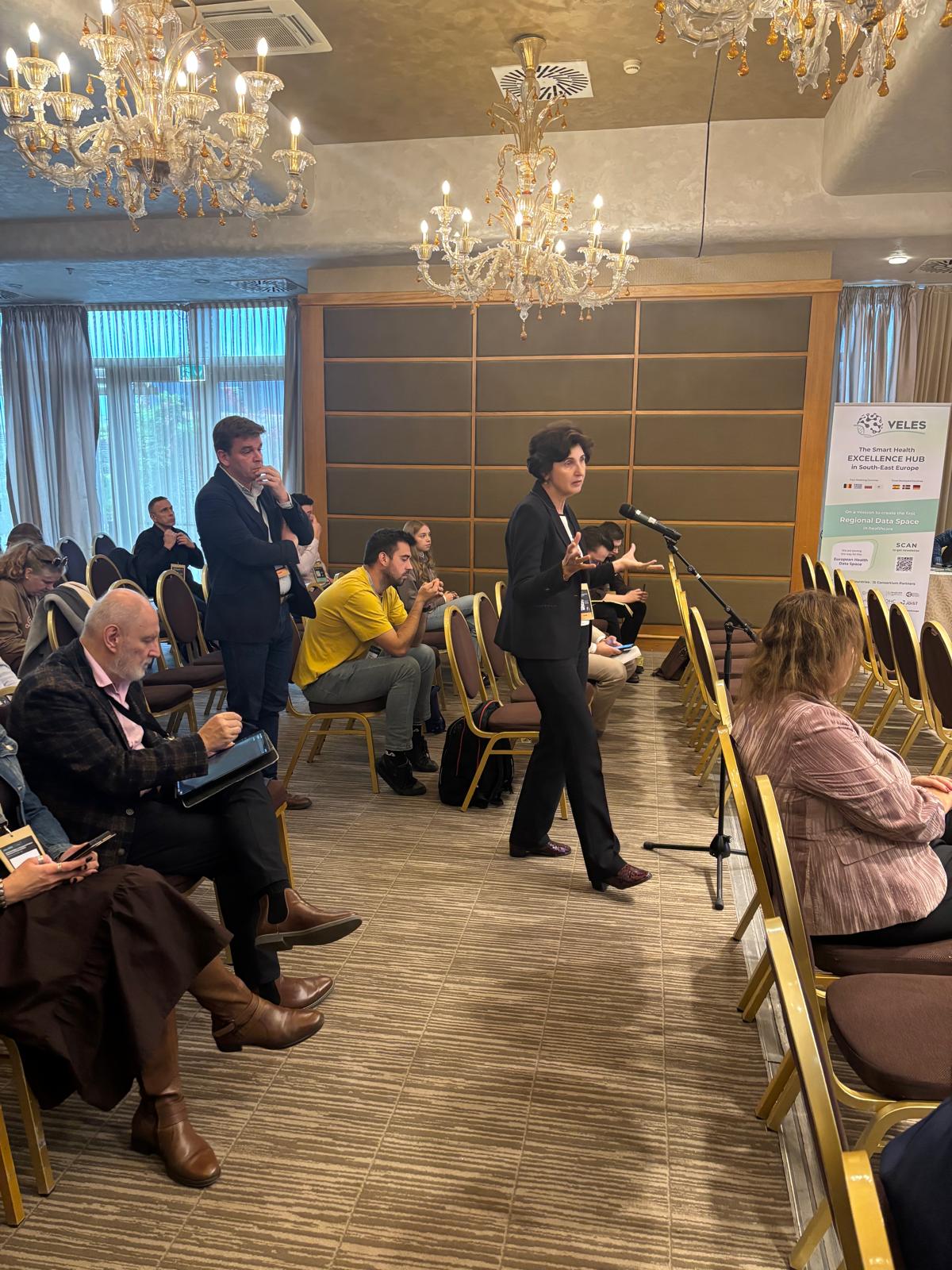
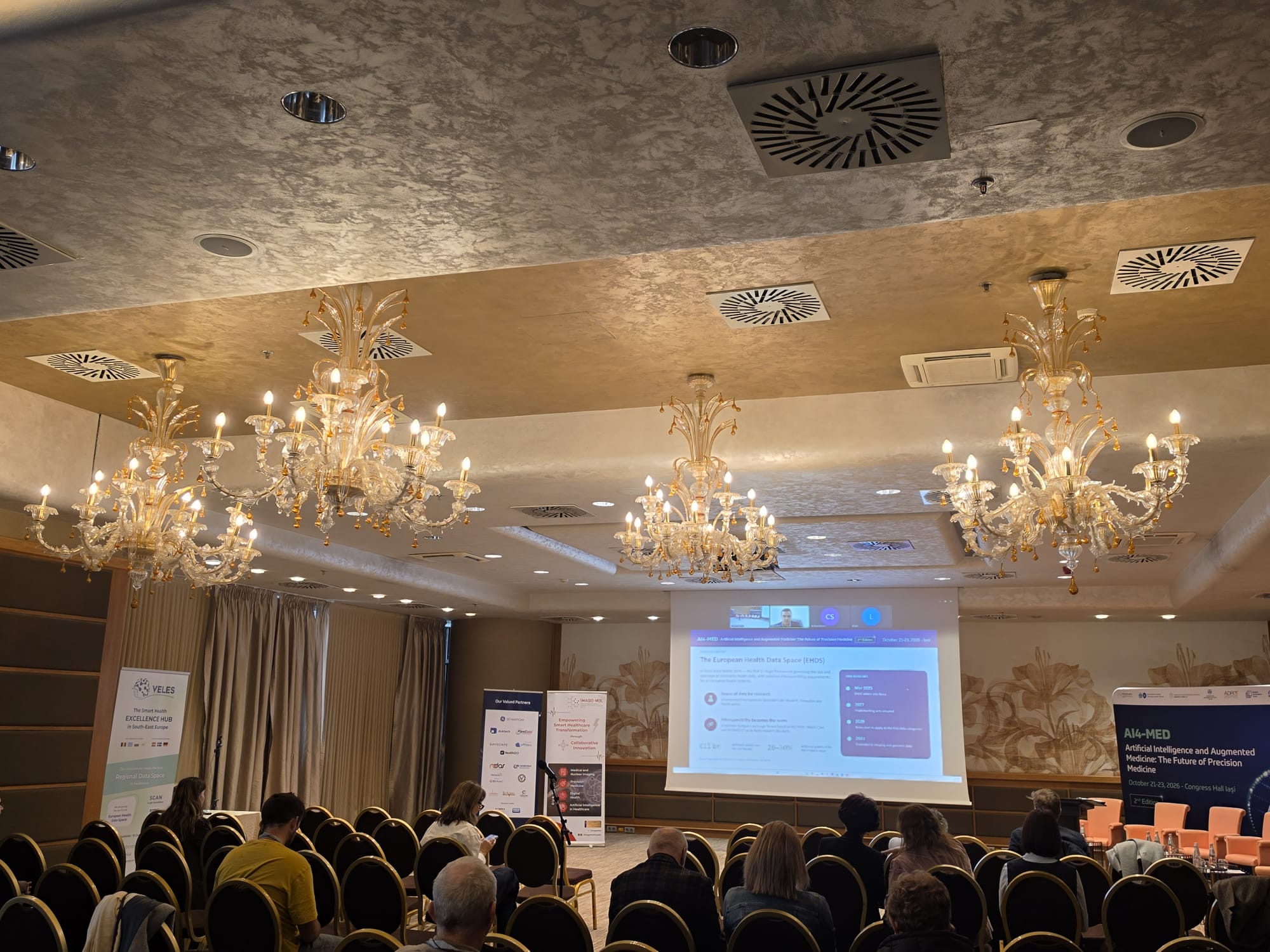
On October 23, the VELES project was represented by Carmen Mihai and Prof. Danisia Haba in the panel Building Together: Collaborative Data Initiatives for Healthcare AI, held during the AI 4 MED conference organised by the Imago-Mol Cluster in Iași, Romania.
Carmen Mihai presented the project and its main lessons learned, while Prof. Danisia Haba showcased the activities and outcomes of the cerebral tumour pilot.
Their key point was that the technical layer is often the easier part; governance, interoperability and sustained collaboration are what make a data space usable for AI.
The other panelists explored related directions. Larisa Mezinu, Vice-President of the National Health Insurance House (CNAS), presented EHDS meets the AI Act: unlocking health data for trustworthy medical AI. Her central message was that the two regulations reinforce each other: datasets obtained through EHDS permits and documented with its quality and utility label provide much of the evidence AI developers need under the AI Act’s data governance rules. Open questions remain, from the undefined notion of “scientific research” and the difficulty of true anonymisation to the capacity of data access bodies and liability when medical AI gets it wrong. Closing these gaps, she concluded, will decide whether precision medicine can scale.
Dr. Octavian Andronic, from the Center for Innovation and e-Health at “Carol Davila” University of Medicine and Pharmacy Bucharest, showcased BioMedLake, a newly launched initiative that builds the infrastructure for secondary use of medical data in line with EHDS. By aggregating clinical data to international interoperability standards, it gives hospitals, researchers and developers shared, research-ready datasets for decision-support algorithms and responsible AI, instead of each team curating its own small collection.
Finally, Dr. Ecaterina Pitel, from “Nicolae Testemițanu” State University of Medicine and Pharmacy, Republic of Moldova, took the discussion beyond EU borders with an overview of Moldova’s health data ecosystem and its future directions. As an EU candidate country, Moldova can design its health data infrastructure with EHDS in mind from the start, and cross-border cooperation with Romanian partners can speed up that journey.
Across all four perspectives, one idea stood out: AI in medicine will scale only on shared, interoperable and trustworthy data. Building that foundation takes clinicians, universities, public authorities, clusters and companies working together, across borders as well as institutions. This is exactly what the VELES project is working towards.